What Antique Fairs Reveal About the Joy of Collecting
There is something quietly special about an antique fair.
Before the doors open, before the conversations begin, there is already a sense that something meaningful is about to unfold. Tables are laid with care. Objects are unwrapped slowly. Glass catches the morning light. Silver rests beside linen. Each piece has travelled a long way — not just in distance, but in time.
In moments like these, it becomes clear that antique fairs are not simply places to buy and sell. They are spaces where stories gather, where curiosity is rewarded, and where the joy of collecting quietly renews itself.
Because antique fairs are not really about objects alone.
They are about connection.
A Different Kind of Atmosphere
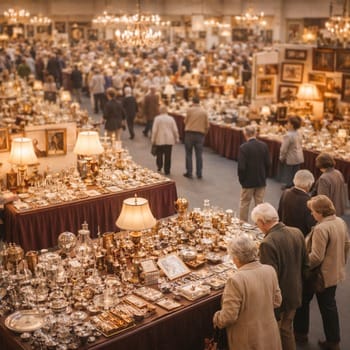
Step into an antique fair and the rhythm immediately feels different from modern retail. There is no urgency in the air. No loud persuasion. No sense of being rushed along.
Instead, there is a slower pace — the kind that invites noticing.
You see people pause longer. They lean in closer. They ask questions not out of obligation, but out of genuine interest. A small porcelain figure becomes a conversation. A piece of cut glass becomes a memory. A brooch reminds someone of a grandmother they haven’t thought about in years.
In these moments, collecting stops being transactional. It becomes personal.
And that is the true atmosphere antique fairs protect.
The Stories That Travel With Objects
Every fair is filled with objects that have already lived full lives.
A vase that once sat in a sunlit hallway. A silver spoon that marked birthdays and quiet dinners. A jewellery box that held small, private treasures.
By the time these pieces reach a fair, they have already moved through decades — sometimes centuries — of hands and homes. Yet they arrive not as relics, but as possibilities.
This is one of the quiet wonders of collecting: objects do not stop living when they change owners. They simply begin another chapter.
Antique fairs make this visible in a way that online spaces rarely can. You can hold something and feel its weight. You can notice the softness of wear. You can see how time has shaped it, not diminished it.
And in that moment, the past feels less distant.
The People Behind the Tables
Another often overlooked beauty of antique fairs is the people who bring them to life.
Behind each table is someone who has spent years learning, searching, restoring, and preserving. Dealers who wake early to travel long distances. Collectors who have spent decades refining their eye. Specialists who can identify a maker from a detail no larger than a thumbnail.
These fairs are, in many ways, gatherings of quiet expertise.
And yet, what stands out most is not the knowledge alone, but the generosity of it. The willingness to share a story. To explain a mark. To recount where something was found.
In a fast-moving world, this kind of patient knowledge feels increasingly rare — and increasingly valuable.
Why Fairs Still Matter
It would be easy to assume that antique fairs belong to another era. After all, so much of life has moved online. Objects can be photographed, listed, shipped, and delivered with remarkable ease.
And yet, fairs continue.
Not because they are convenient, but because they offer something irreplaceable.
They remind us that collecting is not just about acquisition. It is about experience. About discovery that cannot be fully planned. About the quiet thrill of finding something unexpected.
At a fair, you might arrive looking for nothing in particular and leave thinking about a single piece you cannot quite forget. Not because it was rare or valuable, but because it resonated.
This kind of encounter is difficult to replicate through a screen.
If you happen to be near Canberra this March, you may like to experience an antique fair for yourself.
The ACT Seasonal Antique & Collectable Fair will be held on 14–15 March 2026 at the QUOKKA Pavilion, EPIC Park, 10 Flemington Road, Mitchell ACT.
Saturday 14 March: 9am – 5pm
Sunday 15 March: 9am – 4pm
The fair is hosted by the Rotary Club of Murrumbidgee Canberra, with proceeds supporting local charities. Entry is available at the door ($12 general admission, $10 concession).
Antique fairs are not easily described — they are something to be felt in person, in the quiet rhythm of objects, stories, and unexpected discoveries.
A Gentle Invitation to Notice
Perhaps this is what antique fairs reveal most clearly: collecting begins not with buying, but with noticing.
Noticing the curve of a handle. The way light moves through glass. The softness of time on a well-used object. The feeling that something has endured and is still here, waiting to be seen again.
Whether you attend a fair regularly or have never visited one, there is something quietly reassuring in knowing they still exist. That there are still spaces where objects are handled with care, where conversations unfold slowly, and where the past is not rushed aside but gently carried forward.
In a world that often prizes the new and the immediate, antique fairs offer a different kind of rhythm. One that reminds us that beauty can deepen over time. That meaning can accumulate quietly. And that sometimes, the most lasting things are the ones that have already lived a life before reaching us.
And perhaps that is why we continue to return to them — not only to find objects, but to rediscover the quiet joy of collecting itself.