
The Netsuke Beyond the Workshop
Step inside a Meiji-period Japanese workshop and discover the imagined story of a small sumo wrestler netsuke, carved as an old tradition met a changing world. Inspired by a genuine antique from Marple Antiques.
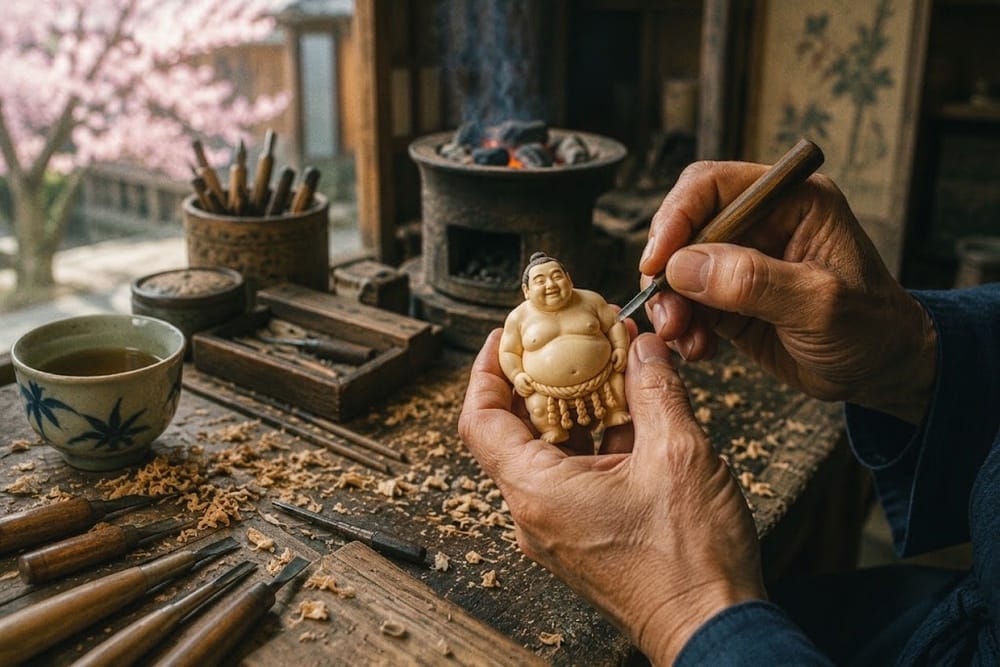
I remember the workshop most clearly in spring. The door was often left open, and cherry blossom from the street sometimes found its way across the wooden floor. There was usually tea beside the carver, forgotten until it had gone cold, and the faint smell of charcoal mixed with the dust and shavings of his work.
He took his time with me. My belly appeared before my face, which seems appropriate for a sumo wrestler. Then came my shoulders, my mawashi and all the small details that could only be appreciated when someone held me close.
My face came last.
By the time he finished, I was smiling.
I have been smiling ever since.
There was nothing new about making a netsuke. Long before my time, during the Edo period, little objects like me had been part of everyday Japanese dress. Traditional kimono had no pockets, so an inrō or pouch could be suspended by a cord from the obi, with a netsuke acting as the toggle that kept everything securely in place.
Some were simple. Others were carved as animals, gods, tradesmen, actors or creatures from old tales. And some, like me, were sumo wrestlers.
What was different was the Japan into which I had arrived.
The old samurai world had gone. In the street outside the workshop, kimono were still everywhere, but now they sometimes passed Western jackets and hats. Telegraph wires stretched above old timber buildings, and occasionally the whistle of a steam train travelled across the rooftops.
The carver rarely looked up when he heard it. Perhaps by then he was accustomed to trains.
He was becoming accustomed to foreigners too.
They came looking for Japanese things. Lacquer, porcelain, bronzes, prints, silks and small carvings were examined with great interest and carried away as reminders of a country that seemed very different from their own.
Netsuke fascinated them.
I can understand why.
We fitted neatly into the hand. Turn us over and there was usually something else to discover: the underside of a foot, folds in a robe, a signature perhaps, or the small himotoshi through which our cord could pass.
By the Meiji period, however, the role of the netsuke was beginning to change. We were still worn and used, but increasingly we were being admired for something beyond our practical purpose. Growing numbers of visitors and collectors from overseas saw in us remarkable miniature works of art. What had once been an everyday object was becoming something to collect and treasure.
I don't know which future my carver imagined for me.
Perhaps he expected me to be worn with an inrō, as netsuke had been for generations. Perhaps he already knew that I might be bought by a foreign visitor and travel somewhere he would never see.
He couldn't have known what actually happened.
Neither do I.
Somewhere along the way, parts of my story disappeared. I cannot give you the name of my first owner or tell you whether I once travelled through a Japanese street secured at an obi. I cannot tell you when I first left Japan, or whose pocket, cabinet or collection held me afterwards.
Perhaps that is why the things I do remember seem so clear.
Cherry blossom moving beyond an open door.
The scrape of a carver's tool.
Tea going cold beside his hand.
The smell of charcoal.
And the moment he lifted me towards the light and looked at the little wrestler he had made.
More than a century has passed since then.
People still pick me up. They turn me over, notice my broad stomach and look closely at my expression. Some find the little holes that reveal what I was originally made to do.
And quite often, they smile.
I like that.
Whatever else my carver intended for me, he gave me a cheerful face. I have crossed years, countries and hands that neither of us could possibly have imagined, yet that small detail remains.
I don't remember every place I have been.
But I remember where I began.
In a workshop in Japan, with cherry blossom outside the door and a craftsman slowly bringing a little sumo wrestler to life.
And Where Am I Now?
The little sumo wrestler at the heart of this story is a genuine Meiji-period Japanese netsuke from the Marple Antiques collection.
Netsuke were already well established during the Edo period (1603–1868), when they served as practical toggles for inrō, tobacco pouches and other small containers suspended from the obi.
During the Meiji period (1868–1912), their world began to change. Western-style clothing reduced the practical need for netsuke, while growing Western fascination with Japanese decorative arts created an enthusiastic new audience of travellers and collectors. Some netsuke continued to be worn, while others were made or sold increasingly with this overseas market in mind.
We do not know whether this particular sumo wrestler was originally worn in Japan or destined for a collector. The carver and the memories imagined in this story are fictional and are not its documented provenance.
What we do know is that the little wrestler survived.
More than a century later, he is still smiling — and today he can be found at Marple Antiques.
Discover the Japanese Sumo Wrestler Netsuke and explore more netsuke from the Marple Antiques collection.
This story is an imagined interpretation inspired by an antique piece from the Marple Antiques collection. The characters, memories and events are fictional and should not be regarded as documented provenance.