
The Superstitions Hidden in Antique Objects
Discover the curious history of antique superstitions, from covered mirrors and lucky horseshoes to hidden shoes, mourning jewellery and witch bottles.
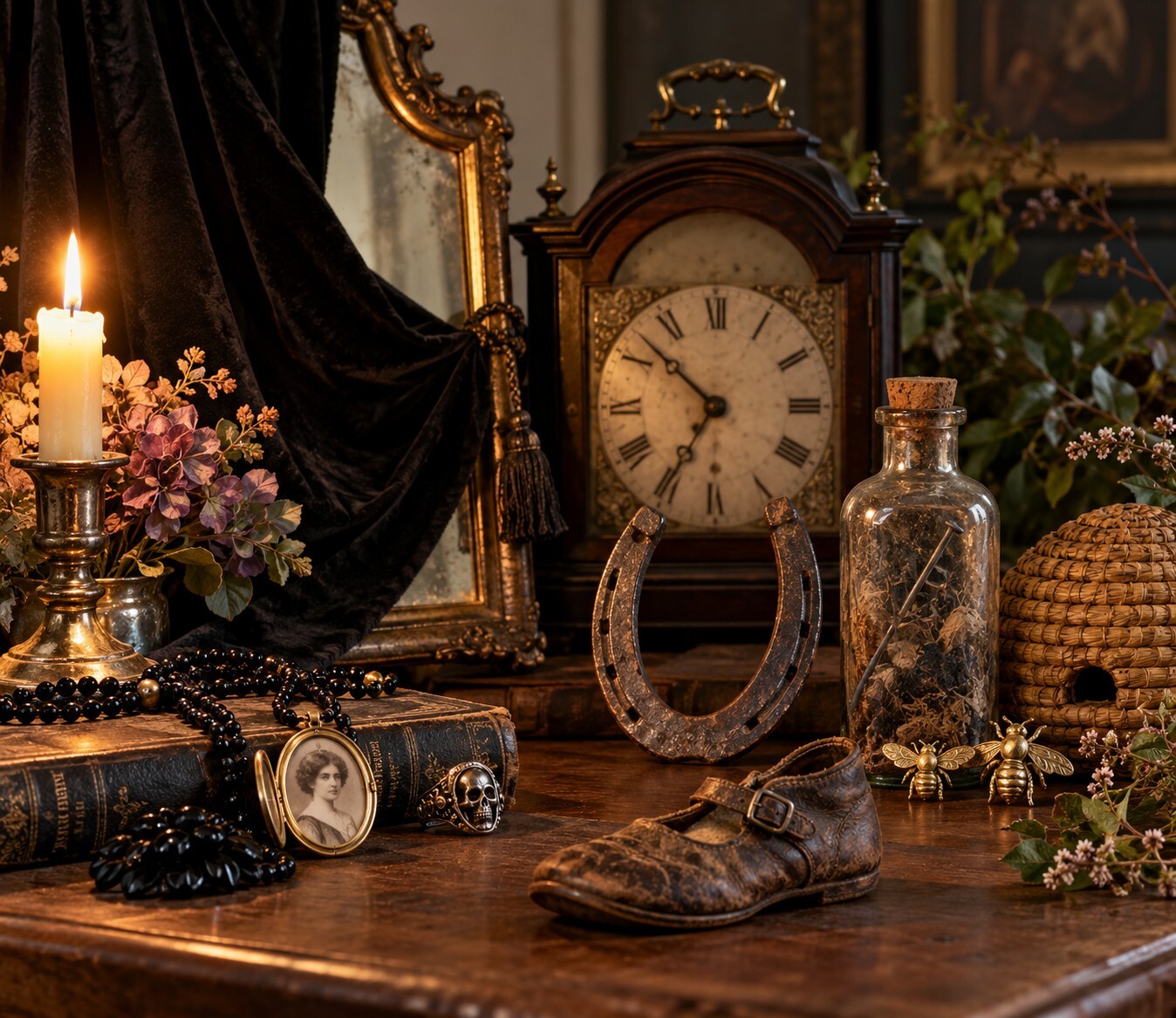
From covered mirrors and lucky horseshoes to hidden shoes and mourning jewellery, the curious beliefs that once surrounded everyday possessions.
An old horseshoe nailed above a doorway, a clock that stopped at an unfortunate moment, or a worn leather shoe discovered behind a fireplace. Today, we might regard these things as curiosities, but to earlier generations they could carry meanings far beyond their practical purpose.
Superstitions were once woven into everyday life. People worried about bad luck, evil spirits, illness and death, and many believed that ordinary household objects could offer protection against the unknown. Some customs were taken very seriously; others were simply passed down through families without anyone remembering how they began.
Many of these traditions have faded with time, although a surprising number remain familiar. Others are so unusual that it's difficult to imagine anyone practising them today.
Why Were Mirrors Covered After a Death?
In some Victorian households, mirrors were covered when someone died. The custom had several explanations, depending on religious tradition and local folklore. One belief held that a person's spirit might become trapped in a reflection, while another suggested that mirrors could distract mourners during a period of solemn reflection.
Covering mirrors was also part of Jewish mourning practice, although its religious explanations should not be confused with Victorian ghost stories.
Imagine entering a house where every mirror had been concealed beneath a dark cloth. Visitors would immediately understand that the household was in mourning. In an age when death often occurred at home, such customs were familiar parts of family life.
The Horseshoe Above the Door
Few objects have enjoyed such a long association with good fortune as the humble horseshoe. For centuries, horseshoes have appeared above doorways, particularly in Britain and Ireland, where iron was traditionally believed to offer protection against harmful supernatural forces.
One popular legend concerns St Dunstan, a tenth-century English saint who, according to later folklore, tricked the Devil into promising never to enter a house protected by a horseshoe.
Even the direction of the horseshoe became a matter of debate. Some believed the open ends should point upwards to hold good luck, while others insisted they should face downwards so that good fortune could fall upon those passing beneath.
Perhaps the safest arrangement was to have one of each.
Mourning Jewellery and Memento Mori
Not every object associated with death was intended to frighten or protect. Some were created simply to remember someone who had been loved.
During the Victorian period, mourning jewellery became particularly fashionable. Black jet brooches, lockets containing photographs, rings engraved with names and dates, and jewellery incorporating carefully arranged locks of hair were all ways of keeping a loved one's memory close.
Long before Victorian mourning jewellery became popular, however, jewellery featuring skulls, skeletons and hourglasses was worn as a reminder of life's uncertainty. These pieces were often associated with the Latin expression memento mori, meaning "remember you must die".
Such jewellery was not necessarily created to commemorate a particular person. It could serve as a reminder of mortality and the importance of living a virtuous life.
To modern eyes, wearing a ring decorated with a skull might seem rather gloomy, but earlier generations were generally more accustomed to visible reminders of death.
When the Clock Stopped
An old clock stopping is hardly remarkable. Springs weaken, mechanisms require attention, and even the finest timepieces occasionally refuse to cooperate.
Yet in earlier times, a clock stopping unexpectedly could be interpreted as an omen, particularly if it happened around the time of a death.
In some households, clocks were deliberately stopped when a family member died, marking the moment of passing. Elsewhere, stories developed around clocks that supposedly stopped of their own accord.
Over generations, family stories have a habit of becoming more dramatic with each retelling. A clock that needed repairing could eventually become the clock that mysteriously stopped at the precise moment someone died.
One can imagine a grandfather clock falling silent in the middle of the night and someone deciding that perhaps it was best not to investigate until morning.
Telling the Bees
Of all the old customs associated with death, telling the bees must be among the most unusual.
In parts of Britain and elsewhere in Europe, beekeepers traditionally informed their hives when an important event occurred within the household. Deaths, marriages and sometimes births were considered matters the bees ought to know about.
When the owner of a hive died, a family member might approach the bees, gently tap the hive and announce the news. In some traditions, black cloth or ribbons were placed around the hives as a sign of mourning.
It was believed that failing to inform the bees could cause them to abandon their hive, stop producing honey or even die.
The practice reflected the close relationship between rural households and the animals upon which they depended. Bees were valuable, and their welfare mattered enormously.
Still, the thought of someone solemnly informing a collection of beehives about a family wedding or funeral is rather touching.
The Shoes Hidden in Walls
Anyone who has renovated an old house knows that unexpected discoveries can turn up behind walls and beneath floorboards. Occasionally, those discoveries include a single worn shoe.
Concealed shoes have been found in chimneys, walls, roof spaces and beneath floors in historic buildings, particularly in Britain. Many date from the seventeenth to nineteenth centuries, although examples from other periods are known.
Why would someone deliberately hide an old shoe inside a house?
One interpretation is that shoes were placed there for protection against witchcraft or harmful spirits. Others suggest they were associated with good fortune, fertility or the safeguarding of a household. Their exact meaning remains uncertain, as the people who concealed them rarely left written explanations.
Interestingly, many discovered shoes are well worn, and some belonged to children.
Imagine pulling apart an old chimney breast and finding a tiny leather shoe that had been hidden there two hundred years earlier. It would certainly make you wonder about the family who once lived in the house.
The Strange History of Witch Bottles
Witch bottles are another example of protective objects deliberately concealed within buildings.
Examples have been discovered beneath floors, near hearths and within the walls of historic houses in Britain. Some contained pins, nails, hair and other materials, and were intended to counter suspected witchcraft or harmful influences.
The practice is particularly associated with the seventeenth century, when fear of witchcraft was widespread, although variations continued into later periods.
Today, archaeologists occasionally uncover these bottles during building renovations. What might initially appear to be an odd collection of discarded objects can turn out to be evidence of a household's attempt to protect itself centuries ago.
It is worth remembering that the people who placed these objects in their homes were not necessarily behaving unusually by the standards of their time. Their beliefs were shaped by a world in which illness, misfortune and sudden death were often difficult to explain.
Are We Really Less Superstitious Today?
Most of us would laugh at the idea of covering every mirror after a death or informing the bees of a family tragedy. Yet plenty of perfectly sensible people still avoid walking beneath ladders, hesitate when a black cat crosses their path or throw spilled salt over their shoulder.
Some of these habits are so familiar that we barely question them.
And perhaps that is the most amusing part of looking back at historical superstitions. We may no longer hide shoes in our walls or worry about spirits becoming trapped in mirrors, but we haven't entirely abandoned the idea that a small gesture might keep bad luck away.
As for that horseshoe above the doorway, I suspect quite a few people would leave it exactly where it is. Just in case.