
The Major Packed the Silver
When Major Edward Harcourt leaves London for South Africa in 1899, an unlikely possession travels with him: a silver table lighter, packed for the quiet evenings he hopes to share with his fellow officers. An imagined story inspired by an 1894 piece now at Marple Antiques.
London, October 1899.
Margaret Harcourt had been watching her husband pack for the better part of an hour when he opened a drawer and took out the silver table lighter.
She said nothing at first. Edward had served in the Army for more than twenty years and knew perfectly well how to pack for a campaign, although she had already quietly removed two shirts and folded them again. His boots were wrapped, his papers secured and his uniform packed with his usual care. Then, among all these sensible preparations for South Africa, he wrapped the table lighter in a handkerchief.
Margaret couldn't help asking whether he really intended to take it.
Edward did.
The lighter had been made in London five years earlier and normally sat downstairs. It was a handsome, solid thing, round in form and standing on four little ball feet, with twin handles and a pair of wands topped with acorns. At home Edward used it for cigars and occasionally for lighting a lamp. Margaret could think of any number of things that might be more useful to a man going to war.
Edward, however, had his reasons. He knew there would be difficult days ahead, but he also knew soldiers. When the day was over and circumstances allowed, there would be a drink, a cigar and perhaps half an hour sitting with his fellow officers talking about anything other than the war. He saw no reason why they shouldn't have a proper lighter.
Margaret had been married to him for twenty-three years. She let him pack it.
And so the little piece of London silver went to South Africa.
War was not quite as people at home imagined it. There was dust that found its way into everything, long periods of waiting, uncomfortable nights and meals Edward generally thought better of mentioning in his letters.
But he had been right about the evenings.
Whenever they could, the officers sat together at the end of the day. Someone might have a bottle to share, another a few cigars, and Edward would produce his silver lighter. They talked about home, complained about the food, argued over horses and laughed at things that probably would not have seemed particularly funny anywhere else.
For a little while, they were simply a group of men having a drink and a smoke together.
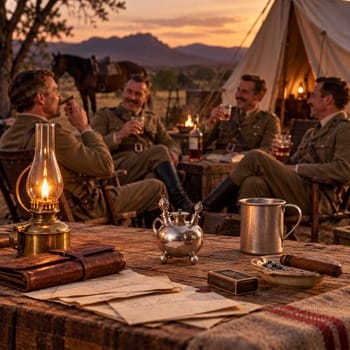
The lighter soon stopped looking out of place.
It was passed around the table, borrowed without asking and occasionally left beside an empty glass until Edward remembered to retrieve it. It lit cigars when they had them and candles when they needed them. Edward also used it to light the small lamp beside him when he sat down to write to Margaret.
His letters rarely said much about the fighting. He wrote instead about a horse that had taken an immediate dislike to him and a young lieutenant who somehow managed to lose one boot. He wanted to know whether the library window had finally been repaired and whether the roses had survived the cold.
Margaret sent back the ordinary news of home. The cook had threatened to leave and then changed her mind. The neighbour's terrier had found its way into the garden again, and the pear tree Edward had been so concerned about had produced almost nothing.
Neither of them wrote very much about being apart.
As the months passed, Edward stopped trying to keep the lighter polished. It travelled wrapped among his belongings and gradually collected the small scratches and marks that came from being used rather than admired.
One evening, while the officers were sitting together, a tired young man caught the edge of their makeshift table as he stood. A glass went over, someone rescued the bottle, and the silver lighter landed on the hard ground.
It survived, but not entirely unmarked. There was now a small dent in its side.
The young officer was terribly apologetic. Edward looked at the damage and told him not to worry about it. By then a perfect piece of silver seemed considerably less important than it once had.
The lighter continued to appear in the evenings.
There were harder periods too, when letters home became less frequent and Margaret sometimes went weeks without hearing from Edward. She knew that post could be delayed and tried not to worry, although she became very familiar with the sound of the postman outside the house.
Then one morning a letter arrived telling her that Edward was coming home.
When he finally walked through their front door, Margaret thought he looked thinner and older. Edward told her she hadn't changed at all, which she dismissed immediately as nonsense. She held him, cried despite having promised herself she wouldn't, and then decided the first thing he needed was a decent meal.
A few days later, while unpacking the last of his things, Margaret found the silver lighter.
It was duller now and scratched from use. When she turned it in her hand she noticed the dent.
“You've ruined your lighter,” she said.
Edward looked at it. “It survived.”
Margaret put it back on the table.
Before long it was being used again, lighting a lamp or a cigar just as it had before Edward left. Visitors to the house would probably have paid little attention to it. To them it was simply a silver table lighter sitting where such a thing might be expected to sit.
They would not have known where it had been. And perhaps that was the most interesting thing about it.
And Where Am I Now?
Major Edward Harcourt and Margaret are, of course, imagined, and there is no evidence that this particular table lighter ever travelled to South Africa.
But when I look at it, I can imagine that it might have.
The real lighter was made in London in 1894 and bears the maker's mark JB. It was made at a time when a table lighter had a practical place in the home, used for lighting lamps, candles and cigars.
And it really does have a tiny dent.
Perhaps it simply slipped from a table one evening. Perhaps someone dropped it while moving house. Or perhaps its story was far more interesting. We will never know, because the person who could have told us is long gone.
That is one of the things I love about antiques. Sometimes it is the smallest detail that makes you wonder where a piece has been and whose hands have held it before yours.
More than 130 years after it was made, this little piece of London silver is now here in Australia at Marple Antiques.
Meet the rare 1894 sterling silver table lighter at Marple Antiques.
This is an imagined story inspired by an antique piece from the Marple Antiques collection. Major Edward Harcourt, Margaret and the events described are fictional and do not represent the documented provenance of the table lighter.