What Makes an Object Collectible?
Why do some objects become highly sought after while others remain overlooked? Discover the role rarity, craftsmanship, condition, provenance and personal connection play in making an antique or vintage piece truly collectible.

Why do some objects become highly sought after while others remain overlooked? The answer is often more complex than age alone.
One of the most common questions asked in antique shops is whether an item is "collectible." At first glance, the answer might seem obvious. Surely older objects are automatically more collectible than newer ones?
In reality, age is only one part of the story.
Some objects become desirable because they are rare. Others because they represent a particular moment in history, showcase exceptional craftsmanship, or simply capture the imagination of collectors. Sometimes even ordinary household items become sought after decades after they were first made.
Understanding what makes an object collectible helps explain why certain pieces continue to attract attention generation after generation.
Age Alone Doesn't Make Something Collectible
Many people assume that if an object is old, it must automatically be valuable or collectible. While age can certainly add interest, it is not the only factor collectors consider.
A mass-produced item that survived in large numbers may be less desirable than a newer piece produced in limited quantities. Likewise, an object can be historically old yet attract little collector interest if there is limited demand for it.
Collectibility is usually created by a combination of factors rather than age alone.
Rarity Matters — But Not Always
Rarity is one of the strongest influences on collectibility. Objects produced in small numbers, limited editions, discontinued patterns, or pieces that rarely appear on the market often attract greater attention from collectors.
However, rarity by itself is not always enough. An item can be extremely rare, yet if few people wish to own it, demand may remain modest.
Collectibility is often created where rarity and desirability meet. This is one reason certain antique glassware, vintage jewellery, decorative ceramics and unusual curiosities continue to attract enthusiastic collectors long after they were first produced.
Condition and Originality
Collectors generally appreciate pieces that remain as close as possible to their original condition. Original finishes, makers' marks, labels, fittings and components often increase a piece's appeal.
That does not mean every collectible must be perfect. Many antique and vintage pieces naturally show signs of age and use, and gentle wear often forms part of their authenticity and charm.
Collectors are usually looking for honest condition rather than perfection. An object that has been carefully preserved over time often tells its story more convincingly than one that has been heavily altered or restored.
Craftsmanship Stands the Test of Time
One reason many antiques remain desirable is the quality of their workmanship. Hand-painted decoration, hand-cut crystal, detailed carving and skilled metalwork continue to attract admiration long after fashions have changed.
Many antique pieces were created by artisans whose techniques required years of training and experience. That craftsmanship remains visible today, even after decades of use and care.
Collectors often value not only the object itself but also the skill, patience and artistry that went into creating it.
Story and Provenance Add Interest
Some objects become collectible because of the stories attached to them. Perhaps they were owned by a notable individual, connected to a particular historical period, or accompanied by documentation that helps trace their journey through time.
Even when a complete history is unavailable, an object's design, materials and craftsmanship can provide clues about its origins. Collectors are often fascinated by these connections to the past.
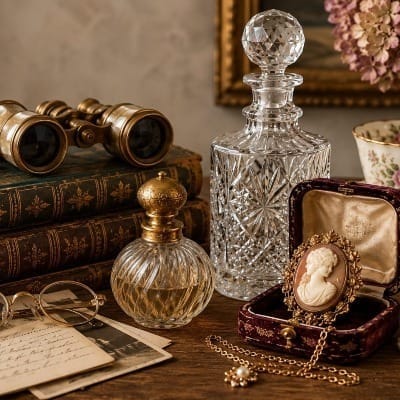
A Victorian brooch, a handwritten inscription inside a book, or a family photograph preserved within a locket can transform an object from something decorative into something deeply personal.
Everyday Objects Can Become Highly Collectible
Many of today's collectibles began life as ordinary household items. Tea cups, perfume bottles, dressing table accessories, books, toys, brooches and decorative ornaments were often purchased simply to be used and enjoyed.
Over time, changing tastes, limited survival rates and growing nostalgia transformed many of these everyday objects into desirable collectibles. This reminds us that collectibility is not always obvious when an object is first made.
Sometimes history decides for us.
The everyday objects that people once took for granted often become the pieces future generations find most fascinating.
Collect What You Love
While rarity, condition and provenance all play a role, experienced collectors often share a simple piece of advice: collect what you genuinely enjoy.
The most rewarding collections are often built around personal interest rather than investment potential alone. Some collectors are drawn to antique glassware and crystal. Others love vintage jewellery, decorative ceramics, books, dressing table treasures or unusual curiosities.
There is no right or wrong place to begin. The best collections often reflect the personality of the collector as much as the objects themselves.
Final Thoughts
There is no single formula that makes an object collectible. Age, rarity, craftsmanship, condition, history and demand all contribute in different ways.
Yet perhaps the most important factor is the connection an object creates. The pieces that continue to be collected, displayed and treasured are often those that spark curiosity, admiration or emotion.
Long after fashions change, those qualities remain timeless.
A Question for Readers
What was the first object you ever collected?
Perhaps it was a piece of jewellery, a favourite book, a collection of teacups, decorative glassware, or something entirely unexpected.
We'd love to hear the story behind your first collection and whether that piece still holds a special place in your home today.
Explore Related Collections at Marple Antiques
Browse our Antique & Vintage Glassware Collection