
The Names I Carried
A Victorian card case remembers the names, hands and lives it once knew — an imagined story inspired by a beautiful antique from Marple Antiques.
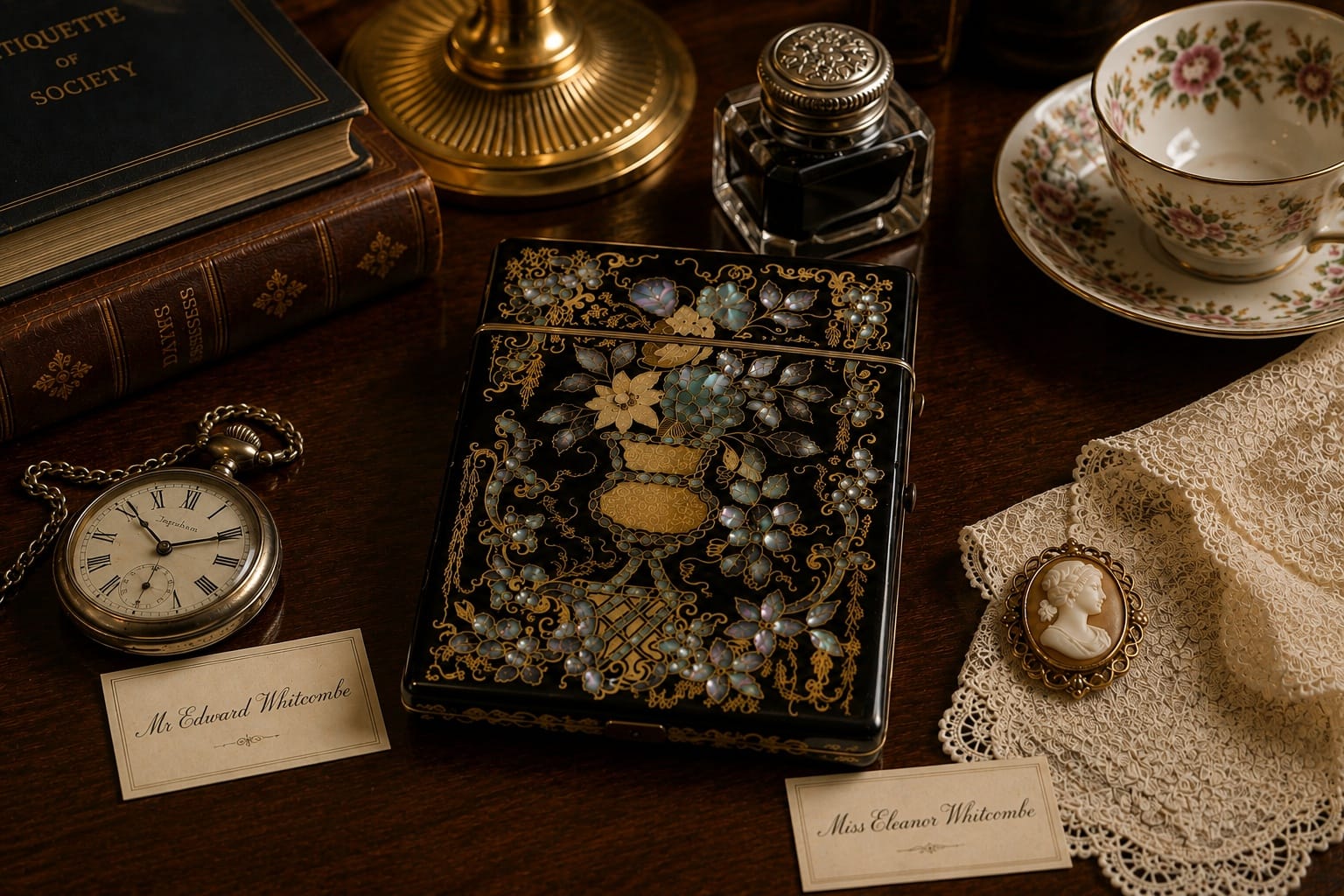
I first belonged to a gentleman named Edward. I remember the smell of his coat: wool when it was dry, damp earth when it was not, and always the faint trace of tobacco that clung to the lining of his breast pocket. I knew his name because I carried it — twenty small cream cards, freshly printed and perfectly crisp. Mr Edward Whitcombe.
Before leaving the house, Edward would take me from the mahogany table in the hall and slip me into his coat beside his watch. I could hear its steady ticking as we travelled through London. There were mornings when the air smelled of rain and horses, afternoons when coal smoke hung heavily over the streets, and summer days when the carriage windows were opened and the scent of gardens drifted through from behind high brick walls.
Edward visited often. I remember doors with polished brass knockers, entrance halls scented with beeswax and flowers, servants taking hats and gloves, and silver trays upon which he sometimes left one of the cards I carried. Not every visit required him to enter. Sometimes his hand simply reached inside his coat, opened my little catch and removed a card. A name was left behind, and we were gone.
For nearly twenty years, I carried Edward's name. Then, one Christmas morning, he gave me away.
His daughter Eleanor had known me since childhood. She had been forbidden to touch me, which naturally meant she did whenever nobody was looking. She loved the pieces of shell set into my black lacquer and would hold me towards the window, watching the mother-of-pearl and abalone change from green to blue, then violet and pink.
“Like magic,” she whispered once.
Edward had heard her. “No magic, Nell.”
She looked disappointed.
He smiled. “Well. Perhaps a little.”
Years later, when he placed me in her hands on Christmas morning, she recognised me immediately.
“You're giving me your card case?”
“No,” Edward replied. “I'm giving you yours.”
Inside me, where his cards had once rested, were new ones bearing another name: Miss Eleanor Whitcombe.
From then on, I travelled with Eleanor. Her world smelled different from her father's. There was lavender and rose water, warm drawing rooms and freshly poured tea. There were winter afternoons scented with wood polish, coal fires and damp wool drying near the grate. I rested beside gloves and reticules while women discussed marriages, illnesses, new dresses and the behaviour of people who were not present to defend themselves.
There were musical evenings, afternoon calls and long waits inside carriages. I heard laughter through drawing-room doors and conversations that became whispers when somebody entered the room. People, I discovered, often speak very freely in front of objects.
There were houses Eleanor approached eagerly and others where I could feel her hesitate before stepping from the carriage. Then there was number twenty-four.
It had rained for most of the afternoon. Eleanor had held me tightly throughout the journey, and by the time the carriage stopped, my lacquer had grown warm beneath her glove. She opened me and removed one of her cards.
Outside, carriage wheels hissed over the wet road. A horse stamped against the stones and coal smoke drifted through the partly opened window. Somewhere nearby, a bakery door opened and for a moment the damp London air smelled wonderfully of warm bread.
Then a gentleman emerged from number twenty-four.
Eleanor became perfectly still.
I did not know him, but I knew immediately that she did. His name was James Harcourt, although I would learn that later.
Eleanor held her card between her fingers for a very long time. I waited. This was what I had been made for. Names were carried. Names were left. Doors opened. That was how this world worked.
But Eleanor did not leave the carriage.
She looked down at Miss Eleanor Whitcombe, then quietly returned the card to me. My little catch closed with a soft click.
“Drive on, please,” she said.
And we did.
I never entered number twenty-four.
Years passed. Edward's hands grew older, and so did Eleanor's. Fashions changed, houses changed and eventually the cards inside me changed too. One day Miss Eleanor Whitcombe disappeared and another name took its place. Later still, there was a gentleman's name inside me once again.
I cannot remember them all now. Perhaps that seems strange, but you must understand — I have carried so many names.
I have rested in gentlemen's coat pockets beside watches and been held in women's gloved hands inside carriages. I have lain on mahogany tables beside silver trays and travelled through streets filled with the sounds of horses, carriage wheels and church bells. I have known the scents of tobacco and lavender, leather and perfume, beeswax, rain and coal smoke.
I have felt hands tremble. I have been opened eagerly, reluctantly and sometimes without thought at all.
The people who carried me believed their names were terribly important. Perhaps they were. But eventually the cards disappeared, the houses changed hands and the voices fell silent.
Somehow, I remained.
My black lacquer is no longer quite as perfect as it once was. Time has touched me, as it touches everything. Yet when the light catches the mother-of-pearl and abalone, the colours still appear — green, blue, violet and pink — just as they did when a little girl named Eleanor secretly held me beside a window and whispered, “Like magic.”
She was right.
Perhaps there was a little magic after all.
I cannot tell you every place I have been, every hand that has held me or every name I once carried. Those stories disappeared long ago.
I cannot tell them, of course.
Or perhaps I just have.
And Where Am I Now?
More than a century has passed since someone first carried me through streets very different from those outside today. The cards I once held are gone, and the names of the people whose pockets and hands protected me have been lost with them.
But my journey is not quite finished.
Today I sit among the antique and vintage pieces at Marple Antiques, waiting for another pair of hands to pick me up. I no longer need to carry someone's calling cards. My purpose may have changed, but the gilt scrollwork is still there, the mother-of-pearl still catches the light, and I still carry the small marks left by a life already lived.
Perhaps my next owner will be a man. Perhaps a woman. Perhaps I will be given as a gift, displayed in a cabinet, kept on a desk or simply treasured because somebody looked at me and wondered where I had been.
You can discover the Victorian Lacquer & Mother-of-Pearl Card Case at Marple Antiques.
This story is imagined and inspired by an antique currently in the Marple Antiques collection. The characters and events are fictional and are not presented as the documented provenance of the piece.